Cross-Cultural Communication Training for Israeli and American Teams
A 4-hour hands-on workshop for companies and organizations that work with Americans. Your team learns how American communication works and applies those insights to real workplace situations.
Participants practice leading meetings, writing effective emails, delivering feedback, and building trust with U.S. colleagues and partners. Each workshop is tailored using a pre-program survey and delivered to groups of up to 15, either on-site or via Zoom. After the session, participants receive a practical toolkit they can use in everyday workplace interactions.
- Format
- A 4-hour workshop, built around practice
- Group
- Up to 15 people
- Ideal For
- International companies and teams working with American colleagues, clients, and business partners.
- Method
- Each session begins with a focused introduction and live demonstration, followed by hands-on practice using real workplace situations. Participants rewrite emails, rehearse conversations, and role-play challenging interactions while receiving practical feedback they can apply immediately.
- Delivery
- On-site or on Zoom
- Language
- Hebrew or English
- Before
- A 20-30 minute scoping call, and a pre-survey for everyone taking part
- After
- Pocket tools for meetings, emails, small talk and feedback
Global Teams Collaborating With U.S.-Based Colleagues, Clients, and Business Partners.
- Teams working with a US headquarters, US customers, partners or investors
- Managers working with U.S.-based colleagues or leading U.S.-based teams.
- Product, R&D, operations, and HR teams working across borders.
- Leadership teams entering or expanding within the U.S. market.
- Teams with varying levels of experience working with U.S.-based professionals.
- Founders and executives building relationships with U.S. clients, investors, and partners.
- Sales and customer-facing teams serving the U.S. market.
A Practical Four-Hour Learning Experience
The four-hour workshop includes approximately 210 minutes of instruction and practice, two 10-minute breaks, and built-in buffer time. We begin by introducing the cultural patterns that shape American workplace communication. Participants then apply these insights to meetings, feedback, and trust-building. Each module combines a concise explanation, a live demonstration, and guided practice using situations from participants' own work.
Opening
Identify how each participant works with American colleagues, clients, or partners.
- Each participant briefly shares how they work with U.S.-based colleagues, headquarters teams, customers, partners, or direct reports.
- An introduction to the cultural expectations that shape how Americans communicate and interpret meaning.
- Participants share what they hope to gain and establish ground rules for an open, productive session.
How Culture Shapes Communication
Explore culture as the unwritten code that shapes how people speak, listen, and interpret meaning.
- Use the cultural iceberg model to explore the visible and hidden forces that shape behavior, including values, norms, laws, rituals, religion, identity, belonging, patterns, symbols, and institutions.
- Explore ethnocentrism, cultural relativism, culture shock, and the "melting pot" model, and how they shape our understanding of cultural differences.
- Compare contrasting cultural values, including collectivism and individualism, mutual responsibility and personal freedom, and familiarity and formal politeness.
- Reflect on a recent cultural misunderstanding by shifting the question from "Why are they like that?" to "Why am I reacting this way?"
Key Cultural Differences
Explore how attitudes toward time, directness, and social norms shape workplace communication.
- Understand the difference between flexible and fixed time commitments, and why arriving even ten minutes late can be perceived as disrespectful in American professional settings.
- Learn how to soften direct feedback with appreciation, context, and constructive suggestions while keeping the message clear.
- Learn how American professionals use small talk and neutral topics to build rapport while maintaining clear personal boundaries.
- A guided discussion to identify the cultural communication gaps affecting your team most.
Clear, Direct Communication That Builds Trust
Stay direct while delivering your message in a way that builds trust.
- In many cultures, direct communication signals honesty, respect, and trust.
- How the Same Message May Be Received in the U.S.
- Use the "aggressively polite" formula to hold your position while expressing it in a more collaborative way.
- Practice rewriting direct messages from your own work so they remain clear while sounding constructive and collaborative.
Learn how to open meetings, set the context, and use softening language to create alignment from the start.
Learn how framing, tone, and context shape the way your message is received.
- Explore cultural metadata, including the tone, context, and unspoken cues that shape meaning beyond the words themselves.
- Recognize what direct communication may leave unstated, including the opening, softening language, acknowledgment of another perspective, and context for the message.
- Practice softening phrases such as "Could we consider...?", "I appreciate your input. I'd like to propose...", and "I see a few potential challenges with this approach."
- Watch a live before-and-after demonstration showing how thoughtful framing can transform the opening of a meeting.
- Build and practice an effective opening for a real meeting with your American colleagues.
Small Talk That Builds Trust
Learn which small-talk topics build connection, which topics to avoid, and how to use conversation naturally to establish trust.
- Build a practical bank of conversation starters for approachable topics such as weather, sports, holidays, work, travel, and entertainment.
- Learn to recognize sensitive topics that require greater care, including politics, race, sexuality, personal finances, religion, and deeply held beliefs.
- Keep small talk light, show genuine curiosity, and give listening as much attention as speaking.
- Participants work in pairs to practice five minutes of natural, trust-building small talk.
Constructive Feedback and Productive Disagreement
Deliver feedback with diplomacy and clarity so your message is understood and acted upon.
- Use the hamburger method to open with genuine appreciation, deliver the message clearly, and close with encouragement and a concrete next step.
- Build a practical toolkit for diplomatic disagreement. Use "I" language, acknowledge other perspectives, ground your message in data, ask thoughtful questions.
- Practice reframing blunt disagreement in a clear, collaborative way.
- Participants work in pairs to deliver feedback on a real work example using the hamburger method.
Bridging Workplace Culture Gaps
Explore how different workplace cultures approach time, planning, task management, and professional relationships.
- Compare a direct, flexible work style with common American workplace expectations. Explore differences in relationship and task orientation, improvisation and planning, flexibility around time and punctuality, personal openness and privacy, creative problem-solving and policy-based processes, and short-term tactics and long-term strategy.
- Explore the difference between long-term planning with quarterly targets and shorter-term planning that leaves room to adapt.
- Compare structured problem-solving through protocols, ticketing systems, and escalation paths with improvising an immediate solution.
- Work through a joint-project scenario in which a technical problem arises, compare how different work styles respond, and develop a shared approach to solving it.
Building on Your Cultural Strengths
Build on what already works and adapt how you communicate it for an American audience.
- Recognize and build on the strengths you already bring, including flexible thinking, genuine relationships, resilience, and adaptability.
- Discuss how to communicate these strengths effectively while preserving what makes them valuable.
Putting It All into Practice
Participants bring everything together by leading a complete meeting from opening to close.
- Simulate a complete meeting with American counterparts, beginning with the opening and small talk, moving through a disagreement, and ending with a clear close.
- See how effective language strengthens communication, builds trust, increases engagement, and leads to better results.
- Close with three practical takeaways and dedicated time for participants' questions.
The great enemy of communication, we find, is the illusion of it.
Practical Skills Your Team Can Apply Immediately
- A clear framework for understanding culture and the unspoken meaning behind the words.
- The ability to communicate directly while sounding constructive, respectful, and collaborative.
- Practical techniques for framing meetings with effective openings, softening language, and clear context.
- Practical strategies for using small talk to build trust, including which topics invite connection and which require greater care.
- A practical guide to common American workplace phrases and the meanings behind them.
- Tools for delivering diplomatic feedback and expressing disagreement clearly and effectively.
- A stronger understanding of how cultural differences shape approaches to time, planning, tasks, and workplace relationships.
- The ability to present your existing strengths in ways that resonate with American colleagues, clients, and partners.
Program Options and Continued Support
Also available
- Executive coaching
- A team training series
- Business English programs
- Keynotes
Everything Your Team Receives
A scoping call
A 20 to 30-minute pre-workshop consultation to align the program with your team's goals and communication challenges.
A Pre-Workshop Survey
Each participant completes a short survey before the workshop, helping us understand the team's experiences, challenges, and priorities.
- The survey identifies where your team already feels confident and where communication with American counterparts becomes challenging.
- Participants share real workplace situations that can be incorporated into the workshop exercises.
- Their responses guide the workshop's focus, examples, and practice activities.
A Practical Takeaway Toolkit
A one-page quick-reference guide that participants can use long after the workshop.
- The Hidden Dictionary of American Workplace Communication
- Practical "aggressively polite" formulas for reframing direct messages.
- A step-by-step checklist for opening meetings with clarity and confidence.
- A guide to small-talk topics that build connection and those that require greater care.
- A clear framework for delivering feedback using the hamburger method.
From Consultation to Workshop Delivery
Initial Consultation
The consultation lasts 20 to 30 minutes. We discuss your team's real workplace situations, define the workshop goals, confirm the date and delivery format, and identify up to 15 participants.
Pre-Workshop Survey
Each participant completes a short survey before the workshop. Their responses help us select relevant examples and tailor the session to the team's priorities.
Tailored Workshop
A four-hour, practice-focused session delivered on-site or via Zoom.
Post-Workshop Support
Every participant receives a practical toolkit for continued use. Organizations can build on the workshop through coaching, an extended training series, Business English programs, or a keynote session.
Everything You Need to Know Before Booking
Who Is This Workshop For?
This workshop is designed for teams working with American colleagues, clients, or partners, including leadership, product, R&D, operations, and HR teams. Sales and procurement teams can choose our American Business Communication program, which focuses on commercial conversations and business relationships.
How Many Participants Can Join?
Each workshop accommodates up to 15 participants, allowing everyone to practice, contribute, and receive feedback.
Is the Workshop Available On-Site and Online?
The workshop can be delivered on-site or via Zoom. In both formats, participants practice in pairs and small groups.
Can the Workshop Be Delivered in Hebrew?
Yes. The workshop can be delivered in Hebrew or English, with the same focus on American workplace culture and communication.
What Level of English Do Participants Need?
Participants should be comfortable using English in everyday workplace situations. The workshop focuses on the cultural meaning surrounding the language, with practice drawn from participants' real work experiences.
How Should Our Team Prepare?
Schedule the initial consultation and share your participant list with us. Each participant will then complete a short survey before the workshop.
Other services
The Confidence Gap in English
A four-hour, hands-on seminar for professionals with strong English who want to communicate with the confidence their expertise deserves. Participants address the habits that weaken confident delivery and practice speaking clearly under pressure in meetings, pitches, calls, and presentations.
Read more
English Groups for Teams
Live, small-group English courses for employees, delivered via Zoom by experienced native English-speaking instructors. Groups of up to 6 are matched by proficiency level, and the 20-session course covers meetings, emails, customer communication, presentations, and negotiations.
Read more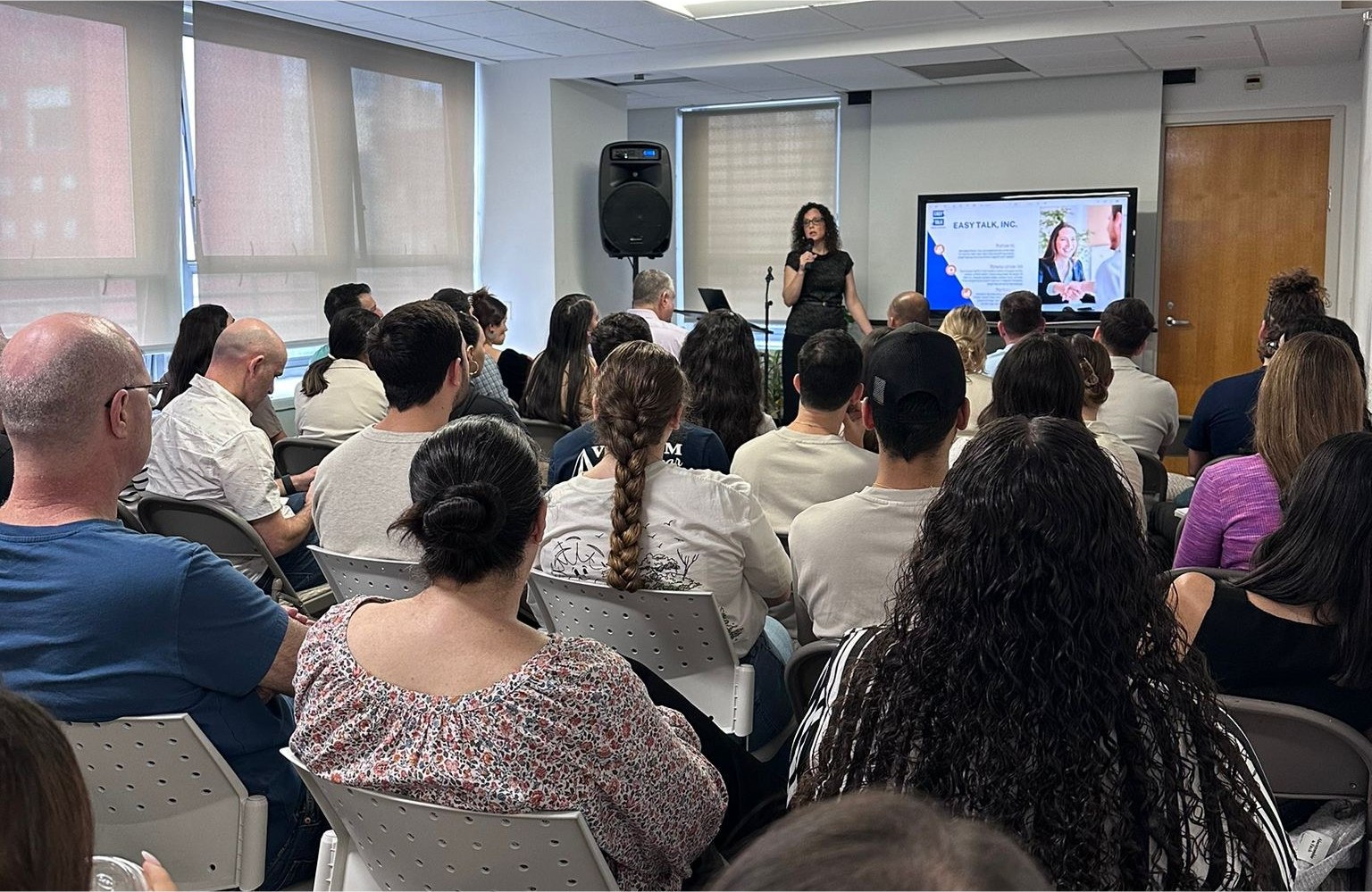
Hebrew Groups for Teams
Hebrew courses for employees who work with Israeli colleagues, head office teams, and clients, in small groups of up to 6 placed by level. There are twenty 55-minute sessions on Zoom with native Hebrew-speaking instructors, for all levels from true beginners to advanced, with private sessions available for an accelerated track.
Read moreTailor-Made Program
A training program designed around your people, their real workplace situations, and the results you want to achieve. Beginning with a program-mapping call and a short participant assessment, we combine workshops, group courses, one-on-one coaching, and keynote sessions into a single plan.
Read more
One-on-One Coaching
One-on-one coaching via Zoom with a professional native English-speaking instructor, tailored to your role, goals, and real communication needs. Our method helps you formulate ideas directly in English instead of translating them from your first language.
Read more
Job Interview Prep in English
One-on-one interview coaching in English, tailored to the role you want. You develop clear answers from your own professional experience, prepare for the questions you are most likely to hear, and practice timed mock interviews followed by focused feedback. Programs include 6 to 12 hours of coaching, scheduled around your interview date.
Read more
English For English-Speaking Kids
A complimentary guide and small online groups that help children maintain their English active and confident and continue growing it, whether they learned it abroad or speak it at home in a non-English-speaking country. Through conversation, age-appropriate activities, and supportive friendships, English becomes a natural part of their lives.
Read more
Easy Talk Webinars
Free live webinars with Yael Elkarat on English and American culture, at work and at home. Each webinar addresses a question our clients ask often, with real examples. Leave your name and email, and we will notify you when the next webinar is scheduled.
Read more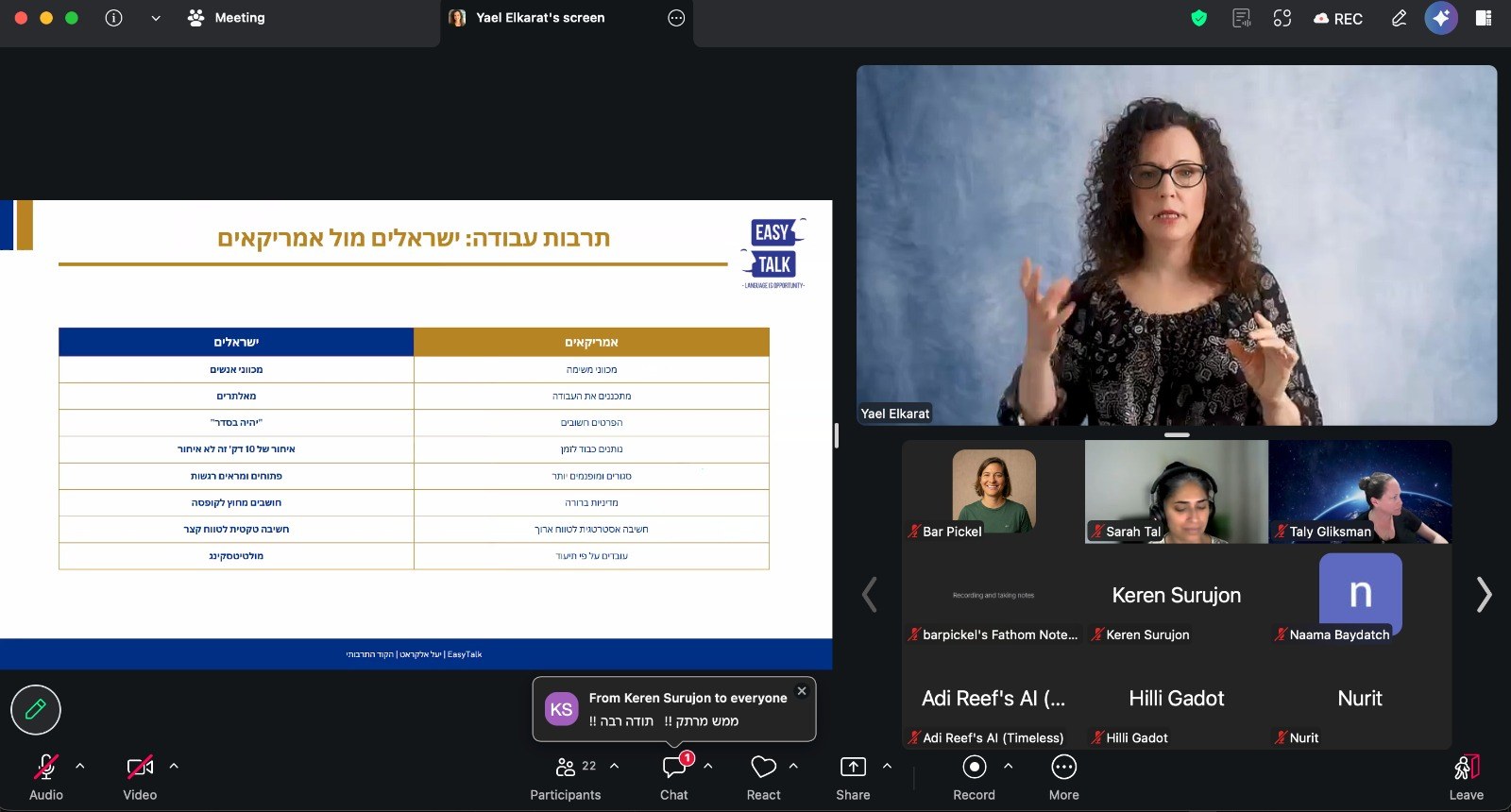
Tell Us About Your Goals and
We'll Recommend the Right Program
Share your language training challenges. We'll recommend the right format and create a plan tailored to your goals.
Opens the calendar here on the page
Tel Aviv · New York · Virtual worldwide
Request a Consultation
Thank you
We have it, and you will hear back within a business day.